Akanthas sensors
Sensors built for real-world conditions
Ruggedness
Every sensor is engineered to work in demanding environments: dust, shocks, temperature swings, humidity, industrial operations.
The enclosures feature reinforced, sealed structures with anti-infiltration protection.
The consolidated solar panel and aluminum frame ensure lasting performance of the power system.
The result: a sensor that runs non-stop on sites facing tough conditions.
Autonomy
Our sensors are built to run without grid power — and with minimal human intervention.
They’re powered by consolidated solar panels, paired with a battery management system optimized for short or low-sunlight days.
The device automatically captures images, runs analyses, and transmits data — adapting to the available charge.
Scalability
Sensors are built to be deployed by the dozen — or across a single zone — without depending on external infrastructure. That scalability relies on total ownership of:
- the hardware
- the firmware
- the connectivity
- the software chain.
Every new sensor integrates automatically into the Akanthas platform (status, battery, associated triggers, analyses sent).
That’s how we can progressively equip large sites and networks of distributed facilities.
Ease of use in the field
The sensor was designed with and for operators — so it can be used without technical training.
Fast installation, an easy-to-orient panel, visible status LEDs, and complementary tools (radio button, laser barrier, light signal) make it simple to operate.
Every field action is designed to be as simple as possible: a press on a remote, a walk past a barrier, or a text message is all it takes.
Maintenance is minimal thanks to the absence of fragile parts and reinforced humidity protection. The goal: let your teams focus on operations — not on our technology.
Artificial intelligence
At the core of the sensor, an AI processing chain automatically analyzes captured images to identify containers, waste flows, and specific situations (fill, drop-offs, anomalies, etc.).
Our AI isn’t limited to detection: it also optimizes analysis frequency, adapts behavior to light conditions, and optimizes energy consumption.
Complementary to the measurement itself, AI delivers usable data in real time — without depending on a server for every micro-action.
Paired with the Akanthas platform, it offers a complete, continuous, and precise operational view — essential for characterization, traceability, and logistics optimization in waste management.
What sets our sensors apart
Warranty
Replacements and updates at no extra cost.
Compliance
The device meets CE standards and GDPR requirements.
Autonomy
The integrated solar panel ensures continuous power — no wiring, no field intervention.
No construction work required
Installation happens without any construction work or wiring needed.
Wide-angle field of view
Dual optics deliver a 180° view — ideal for faithfully analyzing the drop zone.
Minimal maintenance
Rugged, sealed design cuts interventions to the bare minimum — even in tough conditions.
Mount anywhere
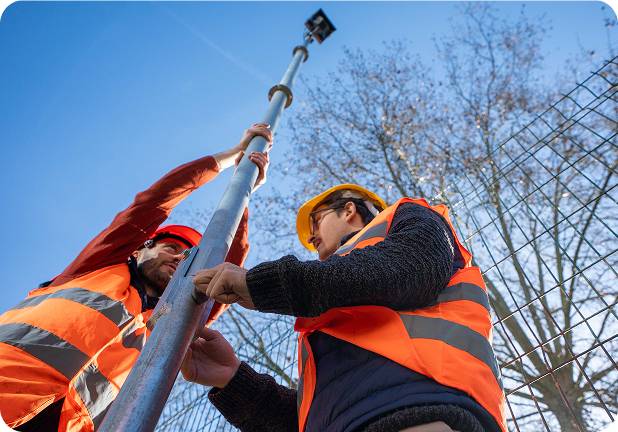
On a wall, a mast, or an existing structure like scaffolding — Akanthas sensors install easily wherever you need them.
Installation
How does deployment work?
1
Installation and calibration
2
Training your teams
3
Verification
4
Usage monitoring
Got a question?
Can the sensor detect hazardous objects in waste?
Recognition capability depends on the type of object, how often it appears in your flows, and the quality of the images captured.
For common objects, our models are already trained. For more specific cases, we enrich the database using your feedback and images collected directly at your sites.
Today, our solution recognizes several categories of hazardous objects, such as:
- Aerosol cans
- Silicone cartridges
- Nitrous oxide canisters
- Car batteries, etc.
There are still some limits. Very small objects (for example a lithium battery) can be hard to identify, especially if partially hidden.
That said, our model keeps improving: the more real-world situations it sees, the more accurate it becomes. Your field feedback directly powers this continuous improvement.
Is installing cameras on containers complicated?
Installing Akanthas sensors is simple, fast, and requires no construction work.
They’re self-sufficient, solar-powered, and 4G-connected — so you can go live on any site without cabling or electrical connections.
Our sensors aren’t video surveillance systems — they’re analytical tools built for the field. Their job is to objectivize flows: measure fill rate, detect sorting errors, identify risk situations.
The images captured are processed automatically by our algorithms — no continuous recording, no intrusion — and are used solely to produce reliable, usable data.
Installation is light, adaptable to any environment — and has a strong operational impact on reclassification reduction, rotation optimization, and operational transparency.
Can we see who sorted incorrectly?
Our solution doesn’t identify individuals — and that’s intentional. It detects sorting errors automatically, without filming or recognizing people, in strict compliance with GDPR. You can track a zone or a flow, but never a person.
The goal isn’t to point fingers, but to correct drift and instill a continuous-improvement culture. We prefer to work on collective approaches that hold teams accountable without creating tension on site.
Could the sensor be stolen, vandalized — or cause GDPR issues?
We fully understand this concern, and we’ve built in several measures to address it. Our system works through image captures, not video — and the sensor is designed to comply with GDPR: it can’t recognize a human face or a license plate.
We also provide a GDPR communication kit to install on the mast to clearly inform your teams and visitors. The sensor is positioned about 4 meters high, making it hard to reach.
Before every installation, we run a risk assessment — and if needed, additional insurance can be set up to protect your investment.
These measures combine physical security with regulatory compliance, while limiting theft and vandalism risks.
Blog
Resources & news
Got a question about our solutions?