Waste Monitoring
Optimize your container management with real-time tracking
Patented AI. Optical sensors. The result: containers collected at the right time, sorting errors caught live, invoices verified automatically.
Zero wasted collections. Zero reclassifications you didn’t see coming.
An AI-powered waste management solution for:
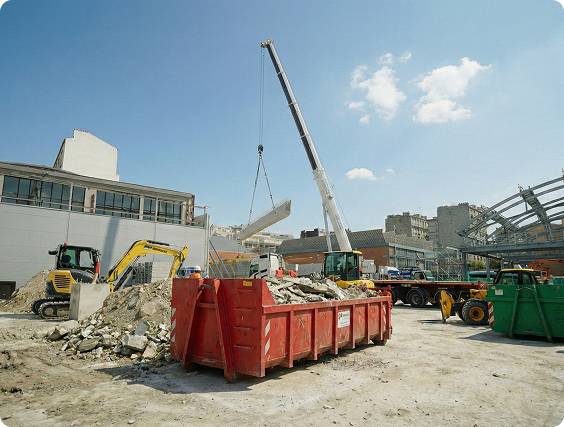
Construction sites and industrial facilities
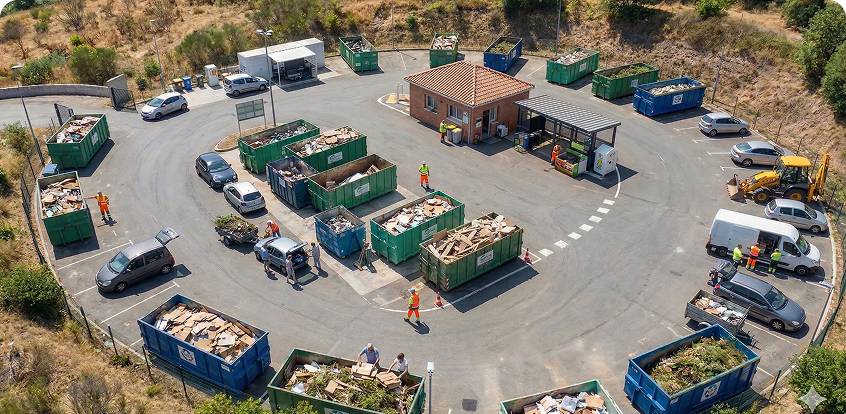
Waste drop-off centers
Why use Waste Monitoring?
Optimize container fill levels
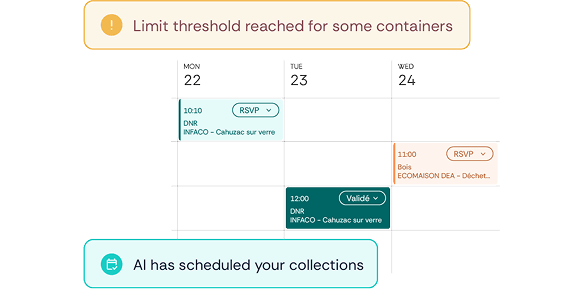
Every container is measured continuously. The AI predicts the optimal collection moment — and can trigger it on its own.
Schedule a compaction in one click or let the system fully automate it.
No more overflows. No more half-empty containers.
Your transport costs drop right away.
Improve sorting at the source
Every sorting error is flagged live. The operator gets an alert with the photo, undesired item highlighted — and acts within the minute.
Fewer reclassifications. Fewer penalties.
Sorting quality improves week after week.
Save time on administration
One interface. Every analysis matched to your invoices.
Unjustified penalties stand out.
In case of dispute: a compliance report with visual proof, emailed straight from the same screen.
Fill levels, compactions, sorting score, anomalies, overall performance — it’s all there.

A complete wastemanagement solution
Container fill-level measurement
Installation by our teams on site. Full setup. API connection to your management tools.
You steer. We operate.
Collection automation
The AI learns each container’s rhythm. It triggers collection at the right time, based on your thresholds.
Manual, semi-auto, or fully autonomous — you choose.
Sorting error detection
Document cross-checking
Every analysis matched to its weighing ticket, its compliance slip, its invoice. In a single interface.
Discrepancies surface. So do unjustified invoices.
Mobile app
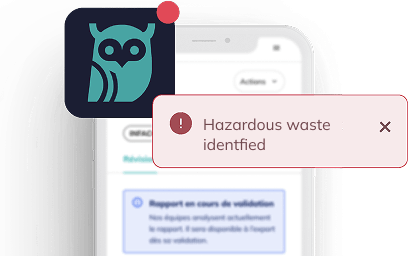
Instant notification on your phone: sorting error, threshold exceeded, collection ordered.
Undesired item highlighted on the photo.
Act directly, from the field.
Centralized data
Rotations, collections, reclassifications: everything converges into a single interface.
History, visual proof, verifiable data.
Nothing gets settled by word of mouth anymore.
The strengths of Waste Monitoring
Autonomy
Solar-powered sensors with 4G communication.
Flexibility
Waste identification in containers or on the ground.
Coverage
One sensor covers up to four containers simultaneously.
Fast installation
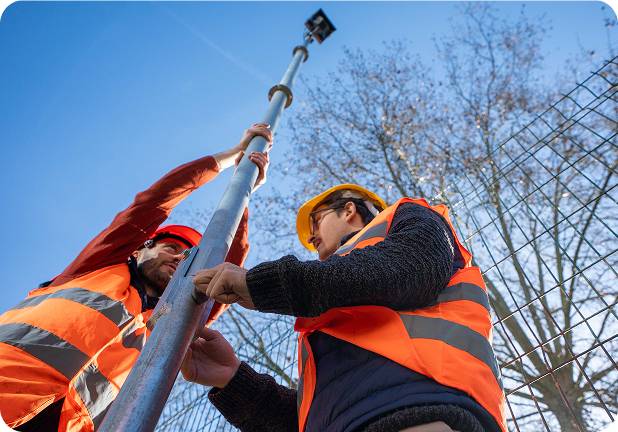
Installed in 20 minutes by our teams — no works, no wiring required.
Customization
Readings configurable to your specific needs.
No hardware to buy
All hardware is rented — you don't buy anything.
Lifetime warranty
Replacement and updates included at no extra cost.
Process
How does deployment work?
1
Installation
2
Training
3
Dedicated follow-up
4
Usage reviews
Move to data-driven waste management. Starting today
Concrete results
- Waste Quality
- Sorting & treatment centers
They use Akanthas every day
Romain Lebegue
Hélène Fenaux
Nicolas Sansus
Kevyn Lodeho
Control Manager – Bouygues Construction
Hélène Denaux
QSE Manager – Premys
Hélène Denaux
Blog
Resources and news
Get our brochure
FAQ
Have a question?
How can we be sure the Akanthas audit is reliable and truly reflects field reality?
Our solution is designed to faithfully reflect field reality. Our sensors measure flows automatically, without human intervention, to avoid subjectivity and guarantee an analysis based on factual data.
Every container or sorting zone is monitored by calibrated optical sensors that detect fill rates, sorting errors, and flow variations.
Data is then timestamped, archived, and correlated with visual proof — ensuring complete, verifiable traceability at any moment.
The audit isn’t a judgment but an objective starting point: it surfaces the losses, reclassifications, and anomalies that used to slip through. You then use those results to adjust practices, identify concrete improvement levers, and build a reliable, measurable view of your operations.
Is installing the cameras on containers complex?
Installing Akanthas sensors is simple, fast, and requires no works.
They’re autonomous, solar-powered, and 4G-connected — so they can be commissioned on any type of site, with no wiring or electrical hookup.
Our sensors aren’t video surveillance systems; they’re field-grade analysis tools. Their role is to objectify flows: measure fill rates, detect sorting errors, and identify risk situations.
Captured images are processed automatically by our algorithms — no continuous capture, no intrusion — and serve only to produce reliable, actionable data.
The installation is lightweight and adaptable to any environment, but its operational impact is strong: fewer reclassifications, optimized routes, and transparent operations.
How can simple alerts help us improve sorting?
An alert lets you catch an error at the right moment, correct it immediately, and hold your teams accountable before bad practices settle in. Across our clients, we see rapid improvement as soon as incorrect sorting is flagged and acted on.
The alert is only a first step: what matters is how you use it. We offer a tailored rollout for each site to turn these alerts into a true sorting management tool.
Can we see who mis-sorted?
Our solution doesn’t identify individuals — and that’s by design. It detects sorting errors automatically, without filming or recognizing people, to strictly comply with GDPR.
You can trace a zone or a flow, but never a person. The goal isn’t to point fingers but to correct drifts and build a culture of continuous improvement. We favor collective approaches that drive accountability without creating tension on the ground.
How far can Akanthas's AI recognize the objects and materials in waste?
Our AI’s recognition capability depends on the object type, its frequency in your flows, and the quality of the captured images. Our models are already trained on the most common objects.
For more specific cases, we progressively enrich our base using images collected on your site and your field feedback. Our AI identifies material families and standard objects observable to the human eye. It does not perform chemical composition analysis (e.g., distinguishing PP, HDPE, etc.).
Like any learning system, performance evolves with exposure: the more it observes, the more it learns and gains precision. Some rarely seen materials (like asbestos) are still less well recognized, but they’ll strengthen as real examples are observed. It’s an evolving system that becomes more powerful as it watches your flows.
Our other solutions
Waste Quality
Waste QualiCheck
Contact us
Have a question about our solutions?